

PM Agent
Beyond the Month-End Close: How AI Financial Intelligence Automates Real-Time Reporting
- 16 February, 2026
- Max 30 min read
 Ami Tran

Table of Content
By the time most CFOs see last month’s numbers, the business has already moved on. Decisions get made on gut feel, estimates, and outdated snapshots. The real data sits locked in a monthly reporting cycle designed for the 1990s.
Here’s the problem: your business runs 24/7, but your financial visibility still arrives in 30-day batches.
Even with modern ERPs and BI tools, finance teams spend weeks reconciling what already happened. They’re explaining the past instead of influencing the future. This gap between financial activity and financial understanding isn’t just an inefficiency. It’s a strategic blindspot that costs companies speed, accuracy, and competitive edge.
In 2026, the month-end close isn’t a milestone. It’s a bottleneck.
This article explores why traditional reporting models are breaking down. It shows how AI-driven financial reporting automation enables continuous, decision-ready insight. And it reveals what finance teams need to finally move beyond the month-end close.
Redefining Expense Approval Speed in 2026
See how modern benchmarks are shifting from manual cycles to touchless, AI-driven approval workflows.
The Efficiency Gap: Why Traditional Reporting Is Always Late
Traditional reporting is rarely late because of a single failure. It’s late because multiple structural inefficiencies stack on top of each other, creating what many finance teams experience as a constant state of catch‑up. These inefficiencies form the manual trap, where effort increases, but speed and clarity do not.
Below are the 5 most common reasons traditional reporting timelines consistently slip:
Data Lives in Too Many Places
The foundation of any report is data, but when it lives across ERPs, billing tools, payroll systems, banks, and spreadsheets, reporting turns into coordination work. Teams spend time locating sources, aligning formats, and resolving mismatches, which weakens real-time financial insights before analysis even begins.
Example: A finance team pulls revenue from a billing system, expenses from spreadsheets, and cash balances from bank portals. Before analysis can start, analysts spend days reconciling totals and explaining why numbers don’t match across systems.
Manual Work Slows Everything Down
Despite modern tooling, reporting still depends on manual steps like copying data, adjusting formulas, and reformatting tables. These tasks are slow, error‑prone, and scale poorly. Without financial reporting automation, insight is delayed by assembly work.
Example: An FP&A analyst manually updates multiple Excel models every reporting cycle, re-copying the same data from exports and fixing broken formulas when formats change.
Reporting Breaks Easily
Many reporting processes rely on fragile workarounds rather than resilient systems. Small issues, like a broken formula or missing entry, can derail an entire reporting cycle.
Example: One late journal entry or overwritten spreadsheet cell triggers a chain reaction, reports are rerun, numbers are rechecked, and deadlines slip while teams scramble to find the source of the error.
Reporting Interrupts High-Value Work
As reporting deadlines approach, finance teams are pulled away from analysis and forecasting into “reporting mode.” This constant context switching reduces focus and slows higher‑value work.
Example: A controller pauses budget planning and business reviews for a full week to support month-end reporting, delaying decisions that depend on forward-looking analysis.
The Reporting Cycle Never Gives Teams a Break
Once one reporting cycle closes, the next begins immediately. Teams move from close to preparation without time to improve workflows, preventing progress toward continuous close processes.
Example: Finance teams rush to deliver reports, only to immediately start preparing for the next close, leaving no time to fix broken processes or reduce manual steps.
Shifting to Autonomous Finance: The Role of AI Agents
Autonomous finance is not about replacing ERPs or core systems, but about enabling financial reporting automation by adding intelligence on top of them. AI agents sit across the finance stack to continuously monitor data, connect activity across systems, and act in real time. Instead of relying on periodic reporting cycles, finance operates with always-on visibility, where reporting, reconciliation, and analysis update continuously as the business changes.
Always-On Automation for Financial Reporting Automation
In autonomous finance, automation is not confined to speeding up individual tasks. AI agents coordinate entire workflows across systems, reducing the need for manual handoffs that typically slow reporting. Data flows are validated, aligned, and updated automatically, allowing finance teams to move away from assembly work and toward interpretation.
This shift changes the role of finance automation from task execution to operational ownership. Instead of asking whether a report has been refreshed or reconciled, teams can assume readiness as the default state.
Built-In Forecasting with AI in FP&A
AI agents transform reporting from a backward-looking activity into a forward-aware capability. By continuously analyzing patterns in financial data, agents surface early indicators of change, such as emerging cost pressure, revenue shifts, or cash flow constraints, before they fully materialize in period-end results.
Forecasts and projections become adaptive rather than static. As new data enters the system, expectations are recalibrated automatically, enabling finance teams to respond to change while outcomes are still influenceable.
Real-Time Risk and Compliance for Autonomous Accounting
Autonomous finance embeds compliance and risk management directly into financial execution. AI agents monitor transactions in real time, checking them against policies, controls, and historical behavior as part of normal operations. Issues are identified as they arise, rather than discovered weeks later during reviews or audits.
This continuous oversight improves accuracy and consistency while reducing the operational burden of after-the-fact controls. Compliance becomes a built-in feature of the workflow, not a separate phase of work.
Designed to Scale with Real-Time Financial Insights
By acting as a connective and reasoning layer across systems, AI agents create a foundation for ongoing innovation in financial analysis and reporting. New data sources, analytical models, or regulatory requirements can be incorporated without redesigning core processes.
As finance environments grow more complex, this flexibility becomes essential. AI agents allow organizations to scale insight, control, and decision-making without scaling manual effort—marking a fundamental step toward autonomous accounting and continuous financial intelligence.
Shifting to Autonomous Finance
Autonomous finance does not mean replacing your ERP or core enterprise systems. It means changing how work happens around them. AI agents sit on top of existing ERPs and connected tools to provide always-on monitoring, allowing finance and operations teams to move from periodic reporting to continuous awareness.
Instead of waiting for people to check data and trigger actions, systems can observe changes, interpret their meaning, and respond in real time. This shift enables modern financial reporting automation to stay current as the business evolves.
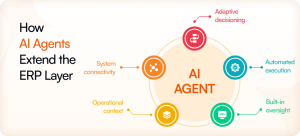
How AI Agents Extend the ERP Layer
Your ERP holds the official financial record, transactions, payroll, inventory, and procurement. But the data you actually need to make decisions lives everywhere else: CRMs, spreadsheets, analytics tools, email threads.
This creates a gap. The insight exists, but acting on it requires manually pulling data from multiple places and piecing it together.
AI agents add an execution layer to existing systems. Rather than replacing ERPs, they connect context, data, and action across tools, supporting ERP integration, maintaining data integrity, and delivering real-time financial insights continuously, without waiting for periodic reports or manual handoffs.
At a high level, this execution layer includes:
- Operational context: Embedded business rules, approval logic, and historical patterns that guide decisions consistently
- System connectivity: Secure integrations that synchronize ERP data with CRM, finance tools, and other enterprise platforms
- Adaptive decisioning: Ongoing evaluation of exceptions, thresholds, and trade-offs to support variance analysis and issue prioritization
- Automated execution: Policy-based updates, approvals, and workflow triggers that reduce manual handoffs and support autonomous accounting
- Built-in oversight: Continuous logging, traceability, and controls that produce audit-ready statements by default
- Process rigor replaces timely action: Structured closings create the illusion of control. In reality, they normalize waiting and turn avoidable delays into standard practice.
How AI Agents Enable Continuous ERP Execution
When AI agents are introduced, ERP workflows stop revolving around reviews, reminders, and manual follow-ups. Instead, execution becomes continuous. Systems monitor activity as it happens and take action within predefined controls, while people focus on oversight and decision-making rather than coordination.
Below are 5 ERP workflows where this shift is easiest to see:
Continuous Finance Operations
In finance, much of the workload comes from validating numbers after the fact. AI agents reduce this burden by keeping financial data aligned as transactions occur.
- Tracking transactions and balances continuously rather than waiting for close
- Surfacing unusual patterns early to support faster investigation
- Keeping reconciliations up to date across systems
- Supporting close preparation with embedded variance analysis and supporting context
- Maintaining audit-ready statements as a byproduct of daily operations
Adaptive Supply and Inventory Flow
ERP planning models struggle with constant change. AI agents help operations adjust in smaller, ongoing steps instead of periodic replanning.
- Interpreting demand signals from ERP, CRM, and external inputs
- Refreshing forecasts as conditions evolve
- Watching supplier reliability and lead-time risk
- Initiating replenishment, rebalancing, or escalation actions when thresholds are met
Scalable Workforce Operations
HR processes often involve repeating the same steps across hires, regions, and policies. AI agents bring consistency without removing oversight.
- Orchestrating onboarding tasks across systems
- Monitoring document completion and approvals
- Responding to common policy questions using ERP and internal knowledge
- Supporting compliance across roles and geographies
Always-On Customer Execution
Customer workflows frequently stall at system handoffs. AI agents help keep execution moving.
- Checking orders for credit, pricing, and fulfillment readiness
- Keeping order and service states aligned across systems
- Resolving standard service requests within policy limits
- Escalating only when predefined thresholds are exceeded
Coordinated Enterprise Execution
Many operational decisions depend on inputs from multiple ERP modules. AI agents help align these signals continuously.
- Evaluating capacity, material availability, and priorities together
- Proposing adjusted schedules as conditions change
- Updating plans directly in the ERP
- Triggering follow-on actions across procurement, logistics, or maintenance
3 Pillars of Automated Financial Intelligence
Automated financial intelligence is not a single feature or tool. It is a system built on a small number of capabilities that work together to keep financial insight current, reliable, and decision-ready. As finance teams move toward financial reporting automation, these 3 pillars define how organizations transition from reactive reporting to continuous visibility.
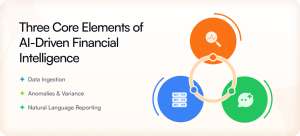
Continuous Data Ingestion Across Systems
Automated financial intelligence starts with data that flows without friction. Instead of relying on periodic exports, AI-driven ingestion connects directly to operational systems such as e-commerce platforms, payment processors, and banks.
This continuous flow strengthens data integrity and ERP integration, eliminating manual uploads and reducing the risk of missing or outdated information. Finance teams no longer wait for data to arrive before work can begin; analysis is always working with the latest inputs.
Early Anomaly and Variance Detection
Once data moves continuously, the next challenge is knowing what requires attention. Automated financial intelligence uses AI to monitor transactions and balances in real time, identifying anomalies and emerging variances before they accumulate.
Rather than discovering discrepancies during the close, finance teams gain early signals through ongoing variance analysis and financial data reconciliation AI. This allows issues to be investigated while they are still small, supporting a faster continuous close process and reducing last-minute corrections.
Natural Language Reporting for Faster Decisions
The final pillar focuses on how insights are delivered. Automated systems translate complex financial activity into clear explanations that executives can act on immediately. Instead of assembling reports manually, AI generates concise summaries that explain what changed, why it changed, and where attention is needed.
By converting structured and unstructured financial data into plain language, finance teams provide real-time financial insights without additional reporting effort. This closes the gap between data and decision-making and reflects the broader future of financial reporting, where insight is immediate and accessible.
Together, these three pillars enable finance teams to move beyond manual consolidation and delayed reporting. They support autonomous accounting, reduce operational friction, and help the finance function as a continuous intelligence layer for the business.
Final Thoughts
Finance teams do not struggle because they lack tools. They struggle because insight arrives too late. When reporting depends on manual consolidation and periodic reviews, finance is forced into a reactive role, explaining what happened instead of shaping what comes next.
Automated financial intelligence changes this dynamic. By combining continuous data ingestion, early anomaly detection, and natural language reporting, finance teams gain visibility while activity is still unfolding. Reporting becomes a living system rather than a monthly event, and decision-making shifts from hindsight to foresight.
The result is not just a faster close, but a different operating model. One where finance spends less time assembling data and more time guiding the business. One where confidence in numbers is built continuously, not rushed at month-end.
If your finance team is still waiting weeks for answers that the business needs today, it may be time to rethink how reporting works. Explore how Blazeup’s AI Finance Agent helps teams move from delayed reporting to real-time financial intelligence, turning weeks of work into insight delivered in seconds.
Frequently Asked Questions
Blazeup is an AI Business Operations Platform built on intelligent AI Agents. Instead of running HR, Finance, ITSM, CRM, and Projects on separate tools, Blazeup unifies everything into one system with one login.
Unlike traditional HRMS or ERP software, Blazeup’s AI Agents don’t just store data—they coordinate workflows, connect teams, and execute work automatically, so operations move faster with less friction.
👉 Explore the platform on Agents Overview
Recent Blogs
Learn how AI Agents automate tasks, unify your data, and surface insights that drive real results.