

Finance Agent
The 2026 Productivity Gap: Why Traditional Finance Operations are Stalling without Finance Agentic AI Workflows
- 29 January, 2026
- Max 30 min read
 Ami Tran

Table of Content
Finance teams have spent the past decade investing in Enterprise Resource Planning (ERP) systems, payroll systems, expense tools, and automation, with the promise of faster execution and better control. Yet in many organizations, finance operations still feel heavy. Month-end closes drag on, approvals move slowly, and leadership often waits too long for reliable financial insight.
As businesses grow more complex, spanning multiple regions, regulations, and data sources, the limits of traditional finance operations become harder to ignore. Automation exists, but it is fragmented, reactive, and dependent on constant human oversight.
This is the software paradox of 2026. Finance is digital, but not autonomous, and the gap between expectations and execution continues to widen.
In this blog, we explore why traditional finance operations are stalling, how manual processes create a productivity gap, and how finance agentic AI workflows are shaping autonomous finance operations in 2026.
Finance Software Paradox of 2026
Finance is digital but not autonomous. Discover what’s holding teams back and what comes next.
Why Manual Processes are Creating a Finance Productivity Gap
Manual work remains prevalent in finance, not due to resistance to change, but because most automation solutions only address isolated tasks. While data capture may be automated, the information still requires manual review, approval, and reconciliation as it moves between systems. These handoffs disrupt workflow continuity and prevent finance teams from operating at the pace modern business requires.
Let’s explore the key friction points below:
Manual handoffs slow decision-making
A manual handoff occurs whenever work or data must be transferred between systems or people for review, approval, or action. Common examples include invoice approvals sitting in email queues, expense reports awaiting manager sign-off, or month-end figures requiring validation across departments.
Each handoff introduces waiting time and requires coordination across teams, often spanning different time zones. As finance operations scale and transaction volumes grow, these delays compound. This turns routine financial processes into lengthy, coordination-heavy workflows.
Process variability breaks traditional automation
In global payroll, expenses, and compliance workflows, processes rarely follow a single predictable path. Regulations vary by country, policies evolve, and operational data is frequently incomplete or inconsistent.
When exceptions occur, automation stops and requires human intervention. Investigations span time zones and teams, creating delays that traditional rule-based systems cannot handle.
Cognitive load shifts focus away from value
As exceptions and handoffs increase, finance teams spend more time tracking statuses, chasing approvals, and resolving errors. This constant coordination significantly raises cognitive load.
Instead of focusing on analysis and strategic planning, finance professionals manage process complexity. Cognitive load reduction becomes impossible when humans must orchestrate every workflow step.
Growth exposes the limits of manual control
As organizations expand, finance processes multiply across entities, systems, and geographies. Each new layer introduces more coordination points and manual oversight requirements.
Traditional automation improves individual tasks but doesn’t scale end-to-end ownership. Finance teams remain the control layer connecting disconnected systems, becoming the bottleneck as growth accelerates.
Tool-Based Automation vs. Finance Agentic AI Workflows
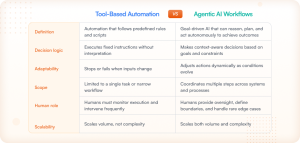
As finance teams scale their automation efforts, a critical distinction emerges: tool-based automation executes individual tasks, while finance agentic AI workflows manage complete processes. This difference determines whether automation simply speeds up work or fundamentally transforms how finance operates.
Core differences between tool-based automation and agentic AI workflows
The fundamental difference lies in how each approach handles work. Tool-based automation executes specific tasks as programmed. Finance agentic AI workflows manage entire processes, adapting as conditions change and maintaining continuity from start to finish.
The table below illustrates how these approaches differ across key dimensions:
How They Compare Across Key Finance Processes
The distinction between tool-based automation and finance agentic AI workflows comes down to how work gets done. Tool-based automation acts like a calculator, processing what it’s given and stopping when conditions change. Finance agentic AI workflows act like an autonomous financial assistant, understanding patterns, anticipating issues, and adjusting actions to keep operations moving.
Below are some common finance processes that highlight how these 2 approaches differ in practice.
Invoice Processing
Tool-based automation captures invoice data and enters it into systems, then stops and waits for humans to review, validate, and resolve any discrepancies before processing can continue.
Finance agentic AI workflows review invoices end-to-end. They cross-check against purchase orders and policies, resolve common discrepancies within defined parameters, and complete posting. Complex exceptions are escalated for human review.
Financial Close
Tool-based automation generates reports only after the period closes. Manual reconciliations and approvals are required before reports can be finalized.
Finance agentic AI workflows enable continuous monitoring throughout the period. They reconcile data on an ongoing basis, flag variances as they occur, and progressively prepare close-ready outputs before period end.
Payroll Operations
Tool-based automation calculates payroll using static rules and predefined logic. When exceptions arise, the system stops and escalates to humans for investigation.
Finance agentic AI workflows enable autonomous payroll processing across different regions and policies. They adapt to variations in regulations and working patterns, processing adjustments within established controls.
Exception Handling
Tool-based automation stops whenever predefined rules are broken. Every exception requires human intervention to investigate and resolve.
Finance agentic AI workflows handle routine exceptions autonomously within defined parameters. They escalate only high-risk cases that require human judgment, keeping most processes flowing.
Solving the "Stall" with Autonomous Finance Operations
Autonomous finance operations resolve the productivity stall by addressing structural weaknesses in how finance is designed and executed. Instead of accelerating isolated tasks, autonomy redesigns finance workflows around outcomes, prevention, and continuous execution.
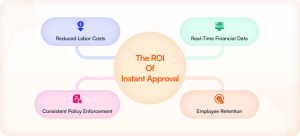
Let’s explore how autonomous finance operations resolve operational friction:
Removing task-level bottlenecks with end-to-end ownership
Finance work slows when responsibility fragments across people and systems. Without a single owner managing the full process, teams spend time chasing approvals, coordinating handoffs, and tracking status updates.
Autonomous finance operations assign end-to-end ownership to workflows. A single AI-powered system manages the complete process, from initiating transactions to validation, approval routing, exception handling, and final posting. When issues arise, the system resolves them within defined parameters or escalates directly to the right person, eliminating coordination loops and reducing cycle times from days to hours.
Shifting from reactive fixes to upstream prevention
Finance issues are often discovered late, when errors surface in reports, payroll runs, or month-end reconciliations. By this point, fixing them requires significant rework, delays close cycles, and disrupts dependent processes.
Autonomous finance operations enable upstream prevention by identifying and resolving issues as transactions occur. The system validates data against policies, cross-checks dependencies, and flags inconsistencies in real time. Problems are corrected immediately, before they cascade or require manual investigation, reducing rework and accelerating close timelines.
Maintaining a continuous view of financial performance
Traditional close cycles concentrate effort at month-end, leaving limited visibility throughout the rest of the period. This creates bottlenecks, last-minute pressure, and delays in the decision-making process.
Autonomous finance operations enable a continuous financial close AI by reconciling and validating data throughout the period rather than only at month-end. Financial positions remain current in real-time, giving leaders timely insights without waiting for the close cycle to complete. This eliminates end-of-period rushes and reduces the time from transaction to actionable financial data.
Lowering cognitive load across finance teams
As finance operations grow, teams spend more time tracking statuses, chasing approvals, and resolving routine issues. This constant task-switching drains mental energy and reduces time available for strategic work.
Autonomous finance operations reduce cognitive load by handling routine execution independently. The system manages tracking, coordination, and standard exceptions without human oversight. This frees finance teams to focus on analysis, judgment, and strategic planning rather than process management.
Benchmarking Success: Closing the Gap
Organizations evaluating autonomous finance operations need clear benchmarks to measure progress. While implementation results vary by complexity and maturity, certain performance indicators consistently reveal whether automation is truly reducing friction or simply accelerating individual tasks.
The metrics below highlight how autonomous finance changes performance across speed, accuracy, and scale:
Close cycle time reduction
Close cycle time measures how quickly finance teams can finalize financial statements after a period ends. Delays usually occur when errors and inconsistencies pile up throughout the month, and teams must investigate and fix them all at once during the close.
Organizations should track:
- Days from the month-end to the completed financial statements
- How often do teams need to make last-minute corrections
- Whether close timing is consistent or varies significantly each period
Success indicator: The close process completes faster and more predictably, with fewer delays caused by last-minute issues.
Exception resolution efficiency
Exception handling shows whether automation actually reduces the work teams do or just moves it around. When something unexpected happens in manual processes—like a missing approval or data mismatch—teams across different departments and time zones must coordinate to fix it, which can take several days.
Key metrics include:
- Average time from exception detection to resolution
- Percentage of exceptions resolved without human intervention
- Volume of exceptions requiring escalation versus autonomous resolution
Success indicator: The system handles most routine issues on its own, resolving them in hours instead of days, and only brings in people for complex situations that truly need human judgment.
Operational cost and resource efficiency
Cost efficiency reveals the total financial impact of autonomous operations. This includes direct savings from reduced manual work as well as indirect benefits from less rework, faster issue resolution, and improved scalability.
Organizations typically measure:
Operational cost savings
- Reduction in time spent on routine tasks like data entry, reconciliations, and document review
- Lower dependency on outsourcing or external vendors
- Decreased coordination overhead across teams
Resource efficiency
- Time allocated to strategic analysis versus routine execution
- Capacity to handle increased transaction volumes without adding staff
- Reduction in rework and corrections
Success indicator: The business can handle significantly more transactions without needing to hire proportionally more people, and the cost per transaction decreases over time.
Team productivity and cognitive load
Productivity improves when finance teams spend less time coordinating work and more time analyzing what the numbers mean. Good automation reduces the constant switching between tasks and lets people focus on strategic thinking.
Key Indicators:
- Percentage of time spent on analysis versus coordination and follow-up
- Reduction in manual monitoring and exception tracking tasks
- Improved capacity for strategic initiatives and forecasting
Success indicator: Finance professionals spending the majority of their time on analysis, forecasting, and strategic planning rather than process management and status tracking.
Conclusion: Future-Proofing with blazeup.ai
Finance teams are under increasing pressure to move faster and scale without adding headcount. As this blog has shown, the root challenge is not a lack of tools but finance workflows that still rely on manual coordination.
Finance Agentic AI Workflows enable a more resilient operating model, where finance execution becomes continuous, adaptive, and outcome-driven. Instead of spending time managing processes, teams can focus on analysis, control, and decision-making.
The finance teams that thrive in 2026 and beyond won’t be those with the most automation tools; they’ll be the ones that eliminate coordination as the bottleneck. Autonomous finance operations aren’t about replacing people; they’re about freeing finance professionals to do the work only humans can do well.
Blazeup supports this shift by helping organizations design practical, AI-native finance operations that scale with complexity.
Book a free consultation to explore how this approach could apply to your finance workflows.
Frequently Asked Questions
Blazeup is an AI Business Operations Platform built on intelligent AI Agents. Instead of running HR, Finance, ITSM, CRM, and Projects on separate tools, Blazeup unifies everything into one system with one login.
Unlike traditional HRMS or ERP software, Blazeup’s AI Agents don’t just store data—they coordinate workflows, connect teams, and execute work automatically, so operations move faster with less friction.
👉 Explore the platform on Agents Overview
Recent Blogs
Learn how AI Agents automate tasks, unify your data, and surface insights that drive real results.